In the global personal care sector, the role of Chinese shampoo manufacturers has evolved from being mere low-cost labor suppliers to sophisticated partners in high-tech R&D and sustainable supply chain management. Whether you’re a startup looking for private-label hair care products or an established multinational aiming to optimize production costs, understanding the intricacies of China’s manufacturing sector is crucial for success.
1. The Chinese Hair Care Product Industry Landscape
China’s cosmetics industry is currently the second largest in the world. However, its manufacturing prowess is arguably number one in terms of vertical integration and time-to-market speed.
1.1 The “Cosmetics Valley” of the East: Guangzhou and Beyond
When searching for a Chinese shampoo manufacturer, the geographical location says a lot about the factory’s specialization.
Guangzhou (Baiyun District): The global hub for hair care product production. Over 70% of China’s hair products are manufactured here. The density of suppliers means a factory can source bottles, pumps, labels, and raw materials within an 8-kilometer radius, significantly reducing lead time.
- Zhejiang and Jiangsu: Known for specialized chemical synthesis and high-end packaging solutions.
- Shanghai: Home to high-tech R&D centers and international-standard laboratories focusing on “premium” hair care product categories.
1.2 Technological Evolution: From OEM to Smart Manufacturing
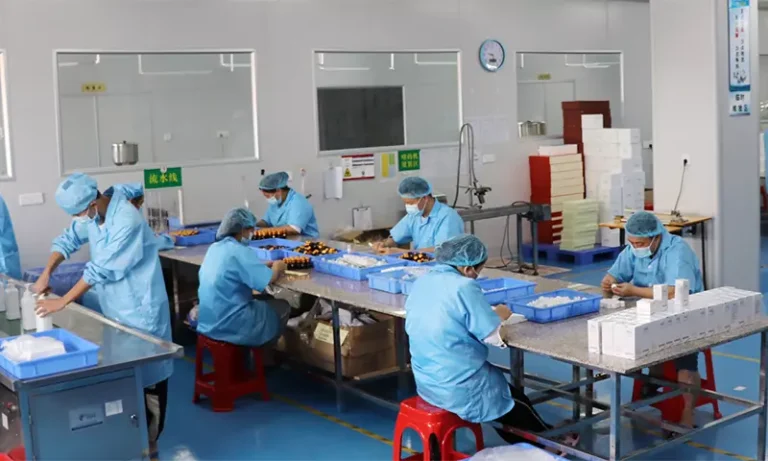
The modern Chinese factory is no longer just a “mixing plant.” Top manufacturers have adopted Industry 4.0 standards, using:
- Automated Vacuum Emulsification: To ensure formulation stability and microscopic-level homogeneity.
- AI-Powered Quality Control: High-speed cameras and sensors detect filling errors or misaligned labels in real time.
- Smart Warehousing: Use of IoT to track batch numbers and expiration dates ensuring global traceability.
Choosing the right business model is the first strategic decision a brand owner must make when contacting a Chinese shampoo manufacturer.
2.1 Original Equipment Manufacturing (OEM)
This model is for brands that already possess their own proprietary formula. You provide the “recipe,” and the factory provides the production line.
- Best for: Established brands that have their own in-house R&D teams.
- Core Value: Scalability and cost-efficiency through mass production.
2.2 Original Design Manufacturing (ODM)
This is the “full-service” model. The manufacturer provides the formula, package design, and production.
- Innovation Catalogs: Leading manufacturers like Nox Bellcow and Adolph have libraries of over 10,000 pre-tested formulas.
- Customization: Even with ODM services, you can request modifications, such as adding a specific plant extract or a unique fragrance.
2.3 White Label vs. Private Label
Although the terms are often used interchangeably, in the Chinese context:
- White Label: A generic, ready-made product for you to put your label on. The minimum order quantity (MOQ) is low, and shipping is fast.
- Private Label: A customized version of an existing formula with unique packaging. This provides better brand differentiation.
3. R&D Trends: What Distinguishes Chinese Manufacturers?
To rank a Chinese shampoo manufacturer, it is essential to discuss the specific product innovations currently trending in the global market.
3.1 Traditional Chinese Medicine Meets Modern Biotechnology
China has a two-thousand-year history of herbal hair care. Manufacturers now use modern extraction techniques (like supercritical CO2 extraction) to bring traditional ingredients to the global market:
- Ginger Root Extract: For scalp stimulation and anti-hair loss.
- He Shou Wu (Polygonum multiflorum): Traditionally used for darkening and revitalizing hair.
- Ginseng and Reishi: Excellent ingredients for “anti-aging scalp” products.
3.2 The Rise of Functional and “Clean” Formulas
Consumers worldwide are demanding “free-from” products. Top Chinese manufacturers now specialize in:
- Sulfate-Free Bases: Using Sodium Cocoyl Isethionate (SCI) or Amino Acid surfactants for gentle cleansing.
- Silicone-Free Technology: Using plant esters to give shine without buildup.
- Microbiome-Friendly Scalp Care: Containing prebiotics and probiotics to balance beneficial scalp bacteria.
4. Quality Control, Certifications, and Global Compliance
A professional Chinese shampoo manufacturer must navigate a complex web of international regulations. This is a critical factor in B2B procurement.
4.1 Essential Global Certifications
Before signing any contract, verify the following qualifications:
- GMPC (ISO 22716) Certification: The gold standard for cosmetics. This certification ensures the facility meets the stringent Good Manufacturing Practices standards required in the US and EU.
- ISO 9001 Certification: Demonstrates a consistent quality management system.
- BSCI/SEDEX Certification: Social compliance audits. Modern consumers care about fair labor; having these certifications protects your brand’s reputation.
4.2 Regulatory Support for International Markets
A high-value manufacturer will assist you with:
- US FDA Registration (MoCRA): Compliance with the new US Modernization of Cosmetics Regulation Act.
- CPNP/SCPN Notification: Notifications for European and UK markets.
- INCI Ingredient Lists: Ensuring each ingredient’s name is internationally recognized and legally compliant.
5. Supply Economics: Costs, MOQs, and Logistics
Understanding the price structure of a Chinese shampoo manufacturer enables better negotiation and higher profit margins.
5.1 Breakdown of a Shampoo Bottle Cost
The cost is typically distributed as follows:
- Base Formula (Liquid): 15% – 30% (higher for functional/organic ingredients).
- Packaging (Bottle/Pump/Label): 40% – 50% (this is often where product differentiation occurs).
- Labor and Manufacturing: 10% – 15%.
- Logistics and Quality Testing: 5% – 10%.
5.2 MOQ Management Strategies
The standard MOQ for custom shampoo production in China typically ranges from 3,000 to 5,000 units. However, you can negotiate for:
- Formula Standardization: If you use the factory’s original formula but with your branding, they may lower the MOQ to 1,000 units.
- Packaging Standardization: Use the same bottle shape for different product types (shampoo, conditioner, body wash) to get higher volume discounts from the bottle supplier.
6. Step-by-Step Guide to Choosing a Chinese Shampoo Manufacturer
6.1 Phase 1: Inquiry (RFQ)
When sending an inquiry, be specific. Instead of saying “I want shampoo,” specify:
- Target Market: (e.g., EU, USA, Middle East).
- Product Function: (e.g., Anti-Dandruff, Color-Safe).
- Reference Product: “I want a formula similar to [Brand Name].”
- Preferred Packaging: (e.g., 500ml PET bottle with a lotion pump).
6.2 Phase 2: Sampling & Lab Testing
- Do not rush this stage.
- Request a sample matching the reference product.
- Test the sample for 2-4 weeks. Check formulation stability and how the scent develops over time.
- Pro Tip: Request a “Freeze-Thaw” test report to ensure the product won’t be damaged by temperature fluctuations during sea freight.
6.3 Phase 3: Mass Production & Third-Party Inspection
Never ship goods without inspection.
- During Production (DUPRO): Inspect the first 10% of production for defects.
- Final Random Inspection (FRI): Conducted by a company like SGS or QIMA to verify final quantity, packaging, and product quality before paying the remaining balance.
7. The Future of Hair Care Manufacturing: Sustainability
Top Chinese shampoo manufacturers in 2026 are heavily focused on “Green Chemistry.”
7.1 Sustainable Packaging Solutions
- Post-Consumer Recycled (PCR) Plastic: Many factories now offer bottles made from 30% to 100% ocean-bound recycled plastic.
- Refill Systems: Durable container designs for products with low-plastic refill pouches.
- Waterless Shampoo Bars: A large-scale trend that reduces shipping weight and eliminates plastic entirely.
7.2 Carbon-Neutral Manufacturing
Leading Chinese industrial zones are transitioning to solar power and water recycling systems. Partnering with a “Green Factory” (an official classification in China) can be an effective marketing tool for your brand’s sustainability report.
8. Conclusion: Choosing the Perfect Partner
Finding the right Chinese shampoo manufacturer is not just about finding the lowest price; it’s about finding a partner who understands your brand’s vision and market regulations. By focusing on R&D capabilities, certification compliance, and transparent communication, you can build a hair care product line that competes globally.
Summary Table: Manufacturer Tier Comparison
| Feature | Tier 1: International ODM | Tier 2: Export-Focused OEM | Tier 3: Local-Scale Factory |
| Best For | Global Brands / Luxury Products | Amazon Sellers / Mid-Market | Wholesale / Low-Cost |
| R&D Capability | High (Patented Ingredients) | Medium (Market-Proven Formulas) | Low (Basic Formulas) |
| Certifications | GMPC, ISO, SEDEX, REACH | GMPC, ISO | ISO Only |
| MOQ | 10,000+ units | 3,000 – 5,000 units | 1,000 units |
| English Support | Excellent / Multilingual | Good | Limited |
FAQ
Q: Can a Chinese shampoo manufacturer assist in registering the product in the European market?
A: Yes, major manufacturers have specialized regulatory departments that can provide the required Product Information File (PIF) and Safety Assessment Report for entry into the European market.
Q: How can I guarantee my formula won’t be copied?
A: Ensure you sign a Non-Use, Non-Disclosure, and Non-Circumvention (NNN) Agreement before sharing your formula details. This agreement is more effective in China than a traditional Western NDA.
Q: What is the typical lead time from down payment to shipment?
A: For the first order, expect 45-60 days (includes packaging design and material sourcing). For repeat orders, it typically takes 25-35 days.