A salon-grade, sulfate-free moisturizing shampoo requires a carefully balanced surfactant system to deliver excellent flash foam and rich lather without the harshness of sulfates. To achieve a premium “salon-grade” feel, the formula must incorporate high-performance conditioning agents (polyquats and natural esters) to offer immediate “slip” during rinsing and a soft after-feel once dry.
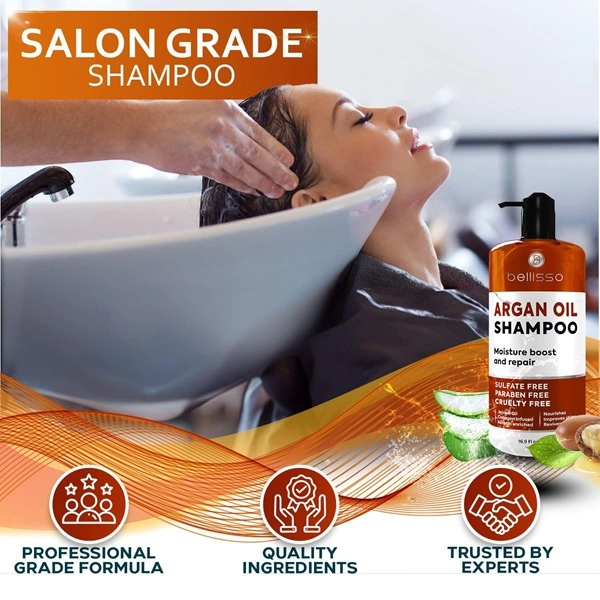
Below is a standard manufacturing formulation guide tailored for Original Equipment Manufacturing (OEM) or Research & Development (R&D) laboratory scaling.
1. Core Formulation Structure (100% w/w)
| Phase | Ingredient INCI Name | Function | Target Weight % |
| Phase A | Water (Aqua) | Solvent / Carrier | Qs to 100.00 |
| Phase A | Glycerin | Humectant | 3.00% |
| Phase A | Polyquaternium-10 | Conditioning Agent & Film Former | 0.30% |
| Phase B | Sodium Lauroyl Methyl Isethionate (SLMI) | Primary Anionic Surfactant (Sulfate-Free) | 10.00% |
| Phase B | Cocamidopropyl Betaine | Amphoteric Co-Surfactant (Foam Booster) | 8.00% |
| Phase B | Decyl Glucoside | Non-Ionic Surfactant (Mildness Enhancer) | 4.00% |
| Phase C | Argania Spinosa (Argan) Kernel Oil | Emollient / Natural Moisturizer | 0.50% |
| Phase C | PEG-7 Glyceryl Cocoate | Refatting Agent / Solubilizer | 1.50% |
| Phase C | Glycol Distearate (and) Laureth-4 | Pearlescent Opacifier (Salon Aesthetic) | 2.00% |
| Phase D | Phenoxyethanol (and) Ethylhexylglycerin | Broad-Spectrum Preservative | 1.00% |
| Phase D | Fragrance (Parfum) | Scent Profiling | 0.60% |
| Phase E | Citric Acid (50% solution) | pH Adjuster | Qs to pH 5.5 – 6.0 |
| Phase E | Sodium Chloride | Viscosity Modifier (Thickener) | Qs (0.5% – 1.5%) |
2. Manufacturing Process Specifications
Equipment Requirements:
- Main compounding vessel equipped with a variable-speed anchor agitator (for sweeping actions) and a high-shear homogenizer (or high-speed disperser).
- Heating/cooling jacketed vessel capabilities.
Step-by-Step Compounding Procedure:
- Phase A (Hydration): Charge the main vessel with Deionized Water. Begin standard propellor/anchor agitation. Slowly sift in the Polyquaternium-10. Mix thoroughly for 20–30 minutes until completely hydrated and clear, ensuring no lumps or “fish-eyes” remain. Add Glycerin and mix until uniform.
- Phase B (Surfactant Phase): Heat the vessel to 60°C – 65°C. Slowly add the primary surfactant Sodium Lauroyl Methyl Isethionate (SLMI). Mix under medium agitation until the flakes/liquid are completely dissolved and the solution is transparent. Add Cocamidopropyl Betaine and Decyl Glucoside, maintaining steady mixing to avoid trapping excess air (foaming).
- Phase C (Emollients & Pearl): In a separate small side-vessel, pre-mix the Argan Oil into the PEG-7 Glyceryl Cocoate until clear. Add this oil blend directly into the main vessel at 60°C. Once homogeneous, introduce the Glycol Distearate blend (pearlescent agent) to give the shampoo its signature premium, opaque salon look. Mix until completely uniform.
- Cooling & Phase D (Post-Additions): Begin cooling the batch down to 40°C. Once the temperature drops below 40°C, add the Preservative and Fragrance. High temperatures will degrade fragrances and deactivate certain preservative systems.
- Phase E (Finishing & Adjustments): * pH Target: Test the pH of the batch. Slowly add Citric Acid in small increments until a skin-and-hair-compatible pH of 5.5 to 6.0 is achieved. (Note: Sulfate-free surfactants are highly pH-dependent for stability and clarity).
- Viscosity Target: Slowly introduce Sodium Chloride (salt) in small increments (0.2% at a time) to build up the thickness to a premium salon density (typically targeting 4,000 – 7,000 cps). Mix until fully smooth.
3. Key Quality Control (QC) Parameters
Before moving from the compounding floor to the filling lines, the batch must meet strict cosmetic validation targets:
- Appearance: Creamy, pearlescent liquid with a uniform white/off-white sheen.
- Odor: Conforming to the designated fragrance standard.
- pH @ 25°C: 5.50 – 6.00
- Viscosity (Brookfield RVT, Spindle 3 @ 20 RPM): 5,000 cps ± 1,500 cps
- Stability Validation: Must pass standard R&D 3-month accelerated stability testing (stored at 4°C, 25°C, and 45°C) along with a 3-cycle freeze-thaw challenge to ensure no phase separation or precipitation occurs during shipping.